

* The term ‘shark’ refers to all species of sharks, rays, and chimaeras.
Text by Jennifer Pytka and Andrea Pauly
What is the Convention on Migratory Species (CMS)?
The Convention on the Conservation of Migratory Species of Wild Animals (CMS), also known as the Bonn Convention, is an intergovernmental treaty under the United Nations Environment Programme (UNEP). It serves as a global platform for the conservation and sustainable use of migratory animals and their habitats. The Convention was signed in 1979 and, as of April 2021, includes 132 Parties.

What is considered a migratory species?
A migratory species is defined as: ‘the entire population or any geographically separate part of the population of any species or lower taxon of wild animals, a significant proportion of whose members cyclically and predictably cross one or more national jurisdictional boundaries.’
Cyclically relates to a cycle of any nature, such as astronomical (circadian, annual etc.), life or climatic, and of any frequency.
Predictably implies that a phenomenon can be anticipated to recur in a given set of circumstances, though not necessarily regularly in time.
Migratory species are listed in two different Appendices (I and II) depending on their conservation status. However, it is important to note that a migratory species can also be listed in both Appendices.
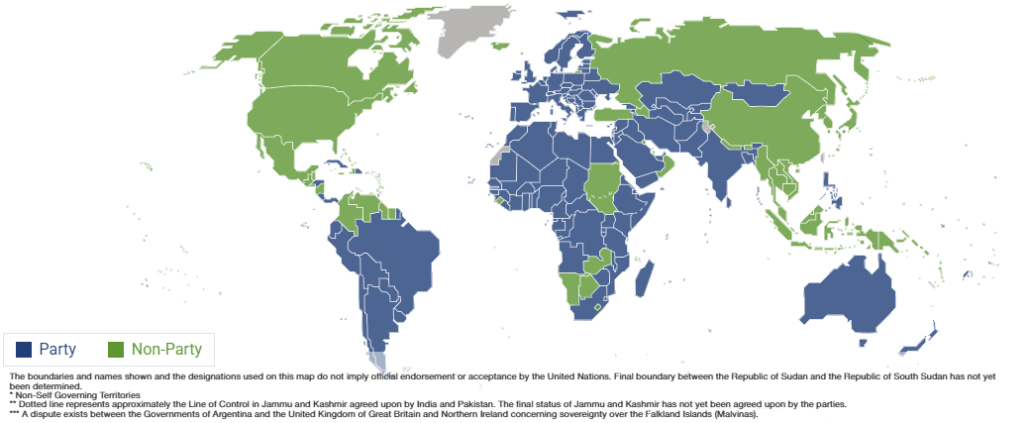
Map showing Parties (blue) and non-Parties (green) to the Convention on the Conservation of Migratory Species of Wild Animals (CMS) (as of September 2026). Source: www.cms.int
What does a CMS-listing mean?
CMS Appendices can be amended at any Conference of the Parties, held every three years. Once Parties agree to listings, these enter into force 90 days later. It is important to note that Parties can also submit a reservation regarding a listing on either Appendix, which exempts the Party from the obligations under the Convention for the species concerned.
When submitting proposals for listings, information on whether the entire or only part of the population undertakes migrations needs to be provided with details of why this should be considered a significant proportion of the population.
An Appendix I listing is for migratory species that are considered endangered. In the context of CMS, endangered refers to a species or regional population that has been assessed as Extinct in the Wild, Critically Endangered, or Endangered using the IUCN Red List of Threatened Species categories and criteria. If a species has been assessed in a lower IUCN Red List threat category (e.g., Near Threatened), a special consideration can be made for an Appendix I listing if its status is deteriorating and the listing would be beneficial for its conservation.
A Range State is any State that exercises jurisdiction over any part of the range of a migratory species, or a State, flag vessels of which are engaged outside national jurisdictional limits in taking that migratory species.
For all species listed on Appendix I, Range States shall endeavour to conserve or restore habitats important to a migratory species’ positive conservation status, take actions to prevent or reduce obstacles to migration, as well as measures to prevent factors that are endangering species. These Range States shall prohibit the taking of all Appendix I-listed species. However, exceptions to the prohibition can be made for (1) scientific purposes, (2) enhancing the propagation of the species, (3) traditional subsistence use, and (4) extraordinary circumstances.
Taking refers to taking, hunting, fishing, capturing, harassing, deliberate killing, or attempting to engage in any of the stated conducts.
An Appendix II listing is for migratory species which have an unfavourable conservation status and which require international agreements for their conservation and management, as well as those which have a conservation status which would significantly benefit from the international cooperation that could be achieved by an international agreement. A species that has been assessed as Extinct in the Wild, Critically Endangered, Endangered, Vulnerable, or Near Threatened on the IUCN Red List is eligible for consideration.
If one of the following criteria for a favourable conservation status are not met, a species is considered to have an unfavourable conservation status. These include:
- population dynamics data indicate that the migratory species is maintaining itself on a long-term basis as a viable component of its ecosystems;
- the range of the migratory species is neither currently being reduced, nor is likely to be reduced, on a long-term basis;
- there is, and will be in the foreseeable future sufficient habitat to maintain the population of the migratory species on a long-term basis; and
- the distribution and abundance of the migratory species approach historic coverage and levels to the extent that potentially suitable ecosystems exist and to the extent consistent with wise wildlife management.
Which species are covered by the Convention?
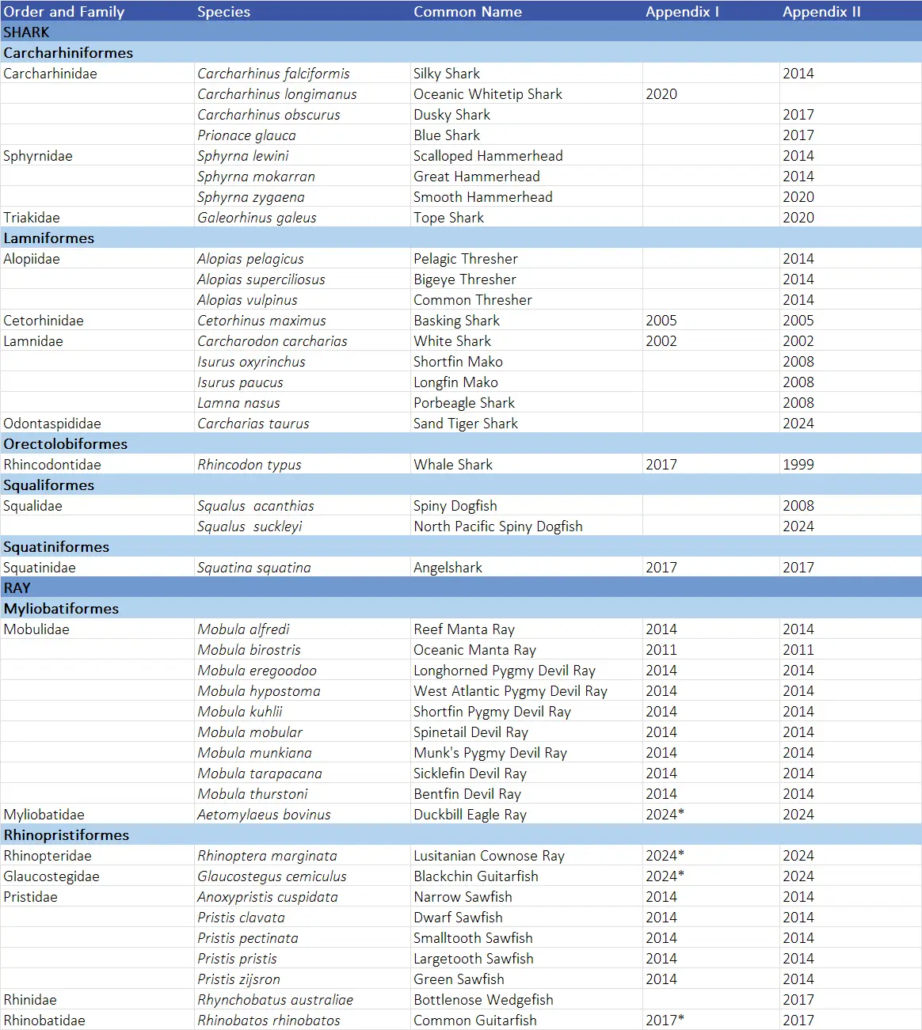
There are currently 40 shark species listed on CMS. The following table provides information on each of these species along with the Appendix they are listed on and the year they were listed.
Further reading
- CMS, Convention on the Conservation of Migratory Species of Wild Animals, cms.int/en
- CMS, Convention Text, 23 June 1979, available at cms.int/en/convention-text
- CMS, Bycatch, 5 December 2017, UNEP/CMS/Resolution 12.22, available at cms.int/en/document/bycatch-0
- CMS, Chondrichthyan Species (Sharks, Rays, Skates and Chimaeras), 7 April 2020, UNEP/CMS/Resolution 13.3, cms.int/en/document/chondrichthyan-species-sharks-rays-skates-and-chimaeras-2
- CMS, Appendices I and II of the Convention on the Conservation of Migratory Species of Wild Animals (CMS), 22 May 2020, cms.int/en/species/appendix-i-ii-cms
- CMS, Concerted Action for the Angelshark (Squatina squatina), 29 May 2020, UNEP/CMS/Concerted Action 12.5 (Rev.COP13), available at cms.int/en/document/concerted-action-angelshark-squatina-squatina-1
- CMS, Concerted Action for the Mobulid Rays (Mobulidae), 29 May 2020, UNEP/CMS/Concerted Action 12.6 (Rev.COP13), available at cms.int/en/document/concerted-action-mobulid-rays-mobulidae-2
- CMS, Concerted Action for the Whale Shark (Rhyncodon typus), 29 May 2020, UNEP/CMS/Concerted Action 12.7 (Rev.COP13), available at cms.int/en/document/concerted-action-whale-shark-rhincodon-typus-2
- CMS, Concerted Action for the Common Guitarfish (Rhinobatos rhinobatos), the Largetooth Sawfish (Pristis pristis) and the Smalltooth Sawfish (Pristis pectinata), 29 May 2020, UNEP/CMS/Concerted Action 13.8, available at cms.int/en/document/concerted-action-common-guitarfish-rhinobatos-rhinobatos-largetooth-sawfish-pristis-pristis
- CMS, Concerted Action for the Common Guitarfish (Rhinobatos rhinobatos) and the Bottlenose Wedgefish (Rhynchobatus australiae), 29 May 2020, UNEP/CMS/Concerted Action 13.9, available at cms.int/en/document/concerted-action-common-guitarfish-rhinobatos-rhinobatos-and-bottlenose-wedgefish
- CMS, Bycatch, UNEP/CMS/Decisions 13.62 to 13.63, available at cms.int/en/page/decisions-1361-1363-bycatch
- CMS, Chondrichthyan Species (Sharks, Rays, Skates and Chimaeras), UNEP/CMS/Decisions 137.71 to 13.73, available at cms.int/en/page/decisions-1371-1373-chondrichthyan-species-sharks-rays-skates-and-chimaeras