

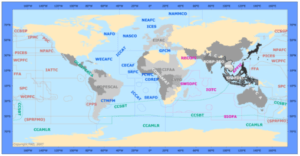
Regional Fishery Management Organizations (RFMOs) as recognized by the Food and Agriculture Organization of the United Nations (FAO)
Many shark species migrate out of national jurisdictions into the high seas, making international cooperation essential to effective shark conservation. International fisheries management is the responsibility of a network of Regional Fishery Management Organizations (RFMOs) with varying degrees of legal competence for setting limits on fishing for sharks (including rays).
A major first step in the process of regulating shark fishing in RFMO waters was a prohibition on shark finning (defined as slicing off a shark’s fins and discarding the body at sea). Finning is now prohibited by most RFMOs, but problematic loopholes still exist (Fowler and Seret 2010). To close these loopholes, many RFMOs are undergoing changes to their finning regulations, from a fins-to-carcass ratio to mandating that sharks are landed with their fins naturally attached (“fins-attached”). These changes, however, have stalled for several RFMOs (some examples are outlined below). Additionally, it is important to note that a great number of countries party to these RFMOs have yet to regulate shark finning in their national waters, and implementation of the RFMO regulations varies among countries, limiting their effectiveness.
Detailed information on shark measures adopted by RFMOs is included in the report from the IUCN SSG Pelagic Shark Red List Workshop, The Conservation Status of Pelagic Sharks and Rays.
 The Commission on the Conservation of Antarctic Marine Living Resources (CCAMLR), established in 1982, is the RFMO responsible for conserving marine ecosystems throughout its Convention Area. To achieve their objectives, the CCAMLR uses an ecosystem-based management approach and has set out the Convention on the Conservation of Antarctic Marine Living Resources (CAMLR Convention), an international treaty adopted in 1980. At the time, the Convention was developed due to rising concerns about unregulated krill catches negatively impacting fauna in the Convention Area, namely for fish, seabirds, seals, and whales. However, as marine mammals were covered in other conventions (i.e., the International Convention for the Regulation of Whaling and the Convention for the Conservation of Antarctic Seals), the CAMLR Convention directed its efforts primarily to crustaceans, finfish, molluscs, and seabirds.
Conservation and Management Measures (CMMs):
The CCAMLR implements a range of legally binding Conservation Measures to support its goals that are reviewed and/or developed annually. There are also non-legally binding Resolutions, which Contracting Parties are encouraged to partake in.
Currently, there is only one CMM specific to sharks and rays (Conservation Measure 32-18: Conservation of sharks); often this species group are included at a higher taxonomic level with other non-targeted species.
This measure is frequently updated, for updated and additional information see here.
 The Commission for the Conservation of Southern Bluefin Tuna (CCSBT) is the RFMO responsible for the management of Southern Bluefin Tuna (Thunnus maccoyii) throughout its distribution. The CCSBT’s objective is to ensure, through appropriate management, the conservation and optimum utilisation of the Southern Bluefin Tuna. As a result of overfishing Southern Bluefin Tuna, in 1985 the primary nations fishing these species (i.e., Australia, Japan, and New Zealand) began to apply strict fishing quotas as a management and conservation measure to enable the tuna stocks to rebuild, which formalised into the Convention for the Conservation of Southern Bluefin Tuna in 1994.
Conservation and Management Measures (CMMs):
The CCSBT implements a range of measures to achieve their conservation goals, including the legally binding Recommendations and non-legally binding Resolutions, which Members are encouraged to partake in.
Currently there are no shark- or ray-specific CMMs, these species are often included under the broader ‘ecologically related’ species group.
Examples of current shark- and ray-related CMMs:
- Resolution to Align CCSBT’s Ecologically Related Species measures with those of other tuna RFMOs
- Recommendation to Mitigate the Impact on Ecologically Related Species of Fishing for Southern Bluefin Tuna
These measures are frequently updated, for updated and additional information see here.
 The General Fisheries Commission for the Mediterranean (GFCM) is a RFMO under the Food and Agriculture Organization (FAO) of the United Nations. The GFCM aims to ensure the sustainable management and conservation of marine resources in the Mediterranean and Black Seas, as well as the sustainable development of aquaculture. The GFCM was established in 1949 and operates under the Agreement for the Establishment of the General Fisheries Commission for the Mediterranean, which came into force in 1952 and was last amended in 2014. The GFCM’s Area of Application covers the entire Mediterranean Sea, the Black Sea, and connecting waters. This is divided into six subregions: Contiguous Atlantic area, Western Mediterranean, Central Mediterranean, Adriatic Sea, Eastern Mediterranean, and Black Sea.
Conservation and Management Measures (CMMs):
The GFCM has implemented several Decisions for shark conservation, which are split into the legally binding measures (Recommendations, Rec) and non-binding measures (Resolutions, Res).
The first shark- and ray-specific CMM was from 2012, entitled ‘Recommendation GFCM/36/2012/3 on fisheries management measures for the conservation of sharks and rays in the GFCM area of application’. Since then, this Recommendation has been superseded multiple times. Additionally, several CMMs have been made focused on lower taxonomic resolutions.
Examples of current shark and ray-specific CMMs:
- Rec GFCM/47/2024/10: On the Extension of Transitional Management Measures for Sustainable Piked Dogfish Fisheries in the Black Sea (Geographical Subarea 29), Amending Recommendation GFCM/44/2021/10 and Repealing Recommendation GFCM/46/2023/8
- Recommendation GFCM/44/2021/16: On Additional Mitigation Measures for the Conservation of Elasmobranchs in the Mediterranean Sea
- Recommendation GFCM/42/2018/2: On Fisheries Management Measures for the Conservation of Sharks and Rays in the GFCM Area of Application, Amending Recommendation GFCM/36/2012/3
These measures are frequently updated, for updated and additional information see here.
 The Inter-American Tropical Tuna Commission (IATTC) is the RFMO responsible for the conservation and management of tuna and tuna -like species, associated species and their ecosystems, throughout the Eastern Pacific Ocean, from Canada in the north, to Chile in the south. The IATTC was first established by the United States of America and Costa Rica due to their mutual concern in conserving the Yellowfin (Thunnus albacares) and Skipjack Tuna (Katsuwonus pelamis) populations in 1949. However, in response to the decreasing tuna populations, the need for global efforts increased ultimately leading to its expanded range and development of the Antigua Convention in 2003, which came into force in 2010.
Conservation and Management Measures (CMMs):
Resolutions are legally binding regulations addressed to CPCs. The first shark-specific Resolution is ‘C-99-11: Resolution on bycatch implemented in 1999’. Since then, several measures have been adopted. Historically, sharks and rays were included in CMMs along with other species caught as bycatch, but the first shark-specific CMM is the ‘C-05-03: Conservation of sharks caught in association with fisheries in the Eastern Pacific Ocean’, which entered into force in 2005 and remains active to this day.
Examples of current shark and ray-specific CMMs:
- Resolution C-24-05: Conservation Measures for the Protection and Sustainable Management of Sharks
- Resolution C-23-08: Amendment to Resolution C-21-06 Conservation Measures for Shark Species, with Special Emphasis on the Silky Shark (Carcharhinus falciformis), for the Years 2024 And 2025
- Resolution C-19-06: Conservation of Whale Sharks
These measures are frequently updated, for updated and additional information see here.
 The International Commission for the Conservation of Atlantic Tunas (ICCAT) is an intergovernmental fishery organisation, responsible for the conservation of tuna and tuna-like species in the Atlantic Ocean and adjacent seas. It was originally signed in 1966 during the Conference of Plenipotentiaries of the United Nations (UN). To carry out the Convention’s objectives of conserving tuna and tuna-like species, the Commission, with support from Contracting Parties, conducts a series of activities. These include consolidating statistical information on conditions and trends of tuna fishery resources; analysing the impact of existing conservation management measures on tuna and tuna-like populations; recommend studies and investigations to Contracting Parties; publish reports based on their findings; etc.
Conservation and Management Measures (CMMs):
Resolutions and Recommendations are non-binding and binding regulations, respectively, addressed to CPCs. The first shark-targeted measure is the Resolution by ICCAT on cooperation with the Food and Agriculture Organization of the United Nations (FAO) with regard to a study on the status of stocks and by-catches of shark species (95–02), developed in 1995. Since then, several measures have been adopted.
Examples of current shark and ray-specific CMMs:
- [23-10]: Recommendation by ICCAT to Replace Recommendation 19-07 on Management Measures for the Conservation of North Atlantic Blue Shark Caught in Association with ICCAT Fisheries
- [23-11]: Recommendation by ICCAT to Replace Recommendation 19-08 on Management Measures for the Conservation of South Atlantic Blue Shark Caught in Association with ICCAT Fisheries
- [23-12]: Recommendation by ICCAT for the Conservation of Whale Sharks (Rhincodon typus) Caught in Association with ICCAT Fisheries
These measures are frequently updated, for updated and additional information see here.
 The Indian Ocean Tuna Commission (IOTC) is an intergovernmental organisation responsible for the management of tuna and tuna-like species in the Indian Ocean. Its main objective is ‘to promote cooperation among the Contracting Parties (Members) and Cooperating Non-Contracting Parties (CNCPs) of the IOTC with a view to ensuring, through appropriate management, the conservation and optimum utilisation of stocks covered by the organisation’s establishing Agreement and to encourage sustainable development of fisheries based on such stocks.’ The IOTC was established in 1993 at the 105th Session of the Council of the Food and Agriculture Organization of the United Nations (FAO) and entered into force in 1996.
Conservation and Management Measures (CMMs):
Members may adopt Conservation and Management Measures (CMMs) concerning the management of tuna and tuna-like species under the IOTC mandate as well as the fisheries which target them. These decisions are passed in the form of either Resolutions or Recommendations. Resolutions are binding and recommendations are non-binding on the Members, the latter relying on voluntary implementation.
The first resolution related to sharks was 05/05 Concerning the conservation of sharks caught in association with fisheries managed by IOTC. The oldest active resolution directly for specific shark species was adopted in 2012 and targeted the conservation of Thresher Sharks (Alopias spp.) (Resolution 12/09). Since then, several additional resolutions have been implemented by the IOTC that apply to shark and ray conservation in the IOTC area of competence.
Examples of current shark and ray-specific CMMs:
- Resolution 18/02: On Management Measures for the Conservation of Blue Shark Caught in Association with IOTC Fisheries
- Resolution 17/05: On the Conservation of Sharks Caught in Association with Fisheries Managed by IOTC
- Resolution 13/05: On the Conservation of Whale Sharks (Rhincodon typus)
These measures are frequently updated, for updated and additional information see here.
 The Northwest Atlantic Fisheries Organization (NAFO) is an RFMO that operates a large portion of the Atlantic Ocean, including the 200-mile zones of Coastal States — Canada, Greenland, St. Pierre et Miquelon and the United States. In 1949 the predecessor, the International Commission of the Northwest Atlantic Fisheries (ICNAF) was launched as one of the first regional fisheries management body to be established in the world. However, stemming from this NAFO was finalised in 1979 with the objective to ensure long term conservation and sustainable use of the fishery resources in the Convention Area and, in so doing, to safeguard the marine ecosystems in which these resources are found.
Conservation and Management Measures (CMMs):
Decisions decided by the NAFO Commission are implemented as either the legally-binding Resolutions that are applicable on all Contracting Parties, while Recommendations are non-binding suggestions that are encouraged to partake in and have the potential to become a Resolution.
As early as 1994, sharks were included along with other fish species with catch limitations, such as minimum size and total catch quota requirements. However, it was not until 2006 that the first shark-specific CMM was passed (formerly as Article 13 – Conservation and Management of Sharks). Since then, this CMM has been revised multiple times: Article 12 – Conservation and Management of Sharks
This measure is frequently updated, for updated and additional information see here.
 The North-East Atlantic Fisheries Commission (NEAFC) is the RFMO operating throughout the northeast Atlantic. The NEAFC Convention (also known as the Convention on Future Multilateral Cooperation in North-East Atlantic Fisheries) was first established in 1959 as the North-East Atlantic Fisheries Convention, where it was later revised and adopted in 1980, before entering into force in 1982. The aim of the NEAFC Convention is to ensure the long-term conservation and optimum utilisation of the fishery resources in its Convention Area, providing sustainable economic, environmental, and social benefits.
Conservation and Management Measures (CMMs):
Recommendations are legally binding regulations addressed to Contracting Parties that come into force after 50 days from sending notification to Parties. Alongside the conservation measures, Contracting Parties are also obliged to follow the NEAFC Scheme of Control and Enforcement, with sets of regulations covering management in NEAFC, reporting guidelines, fisheries, etc. Specifically, Annex V of the NEAFC Scheme contains the list of species that are to be included in monthly reports, including sharks, rays, and chimaeras.
The first shark-specific recommendation was in 2004: Rec 05 2004: Management measures for deep-sea species in the NEAFC Regulatory Area in 2004. Since then, several measures have been adopted.
Examples of current shark, ray, and chimaera-specific CMMs:
These measures are frequently updated, for updated and additional information see here.
 The Regional Commission for Fisheries (RECOFI) is a RFMO established in 1999 by the FAO Council and came into force in 2001. RECOFI regularly assesses fish stocks and manages fisheries. The Commission carries out its functions and responsibilities in the Arabian/Persian Gulf region, with the objective to promote the development, conservation, rational management and best utilization of living marine resources, as well as the sustainable development of aquaculture in its area of competence.
Conservation and Management Measures (CMMs):
CMMs are developed and implemented by Commission Members in the form of legally-binding Recommendations. Currently, there are two Recommendations, one pertaining to fisheries management and the other to aquaculture. Sharks and rays are included under the former with other species groups: Recommendation RECOFI/6/2011/1 on Minimum Data Reporting in the RECOFI Area.
This measure is frequently updated, for updated and additional information see here.
 The South East Atlantic Fisheries Organization (SEAFO) is responsible for the long-term conservation and sustainable use of fishery resources in the high seas of the South East Atlantic Ocean. SEAFO was established under the Convention on the Conservation and Management of Fishery Resources in the South East Atlantic Ocean, which entered into force in 2003. The objective of the Convention is to ensure the long-term conservation and sustainable use of fishery resources within the Convention Area through effective implementation of the Convention. SEAFO applies a precautionary approach and requires that conservation and management measures are based on the best available scientific evidence. The Convention also requires consideration of the impacts of fishing on ecologically related species and provides for measures to protect biodiversity and minimise harmful impacts on living marine resources.
Conservation and Management Measures (CMMs):
SEAFO adopts legally binding Conservation and Management Measures and the non-legally binding Recommendations, which cover issues including fishing activities, catch and effort limits, vulnerable marine ecosystems, monitoring and compliance, and the conservation of non-target species.
SEAFO has two measures specifically addressing sharks. Conservation Measure 04/06, On the Conservation of Sharks Caught in Association with Fisheries Managed by SEAFO and the Recommendation 1/2008 on Banning of Deep-Water Shark Catches.
Examples of current shark-related CMMs:
- Conservation Measure 04/06: On the Conservation of Sharks Caught in Association with Fisheries Managed by SEAFO
- Recommendation 1/2008: Banning of Deep-Water Shark Catches
These measures are frequently updated, for updated and additional information see here.
 The Western and Central Pacific Fisheries Commission (WCPFC) is an international fisheries agreement that seeks to ensure the long-term conservation and sustainable use of highly migratory fish stocks (i.e., tunas, billfishes, marlins, and sharks) in the western and central Pacific Ocean (WCPO) through effective management. It was established by the Convention for the Conservation and Management of Highly Migratory Fish Stocks on 19 June 2004 and provided a legal framework for fisheries management within the WCPO region. The main aim is to address management problems in high-seas fisheries across the WCPO region. This includes unregulated fishing, over-capitalization, excessive fleet capacity, vessel re-flagging to escape controls, insufficiently selective gear, unreliable databases, and insufficient multilateral cooperation with respect to the conservation and management of highly migratory fish stocks.
Conservation and Management Measures (CMMs):
Conservation and Management Measures (CMMs) describe binding decisions relating to conservation and management measures. In contrast, Resolutions describe non-binding statements and recommendations addressed to members of the Commission and Cooperating non-members.
The first CMM focused on sharks was CMM 2006-05: Conservation and Management Measure for Sharks in the WCPO, which has been updated and replaced frequently since then.
Examples of current shark and ray-specific CMMs:
- CMM 2024-05: Conservation and Management Measure for Sharks
- CMM 2019-05: Conservation and Management Measure on Mobulid Rays caught in association with fisheries in the WCPFC Convention Area
- Resolution 2005-03: Resolution on Non-target fish species
These measures are frequently updated, for updated and additional information see here.