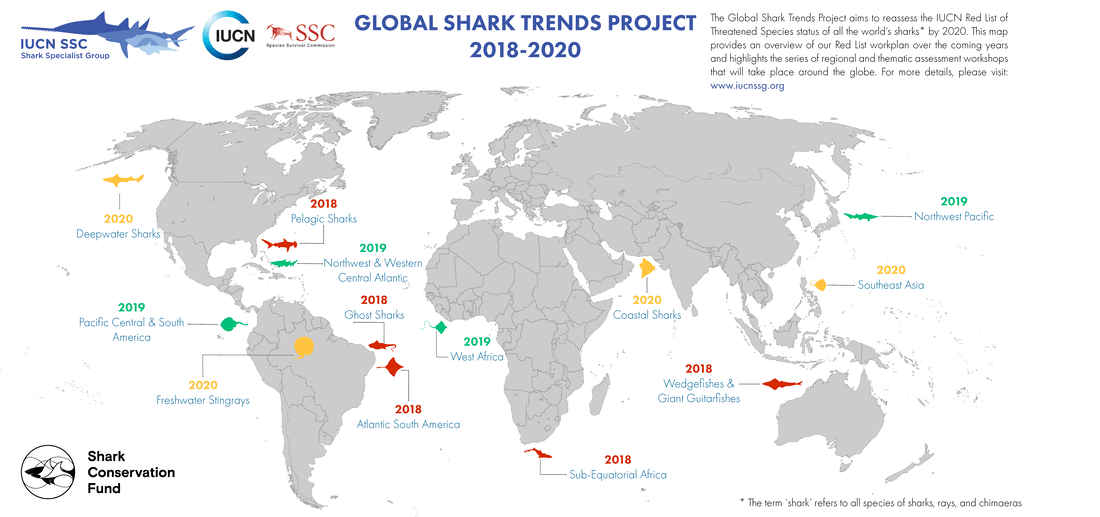
Assessing and reassessing the extinction risk of chondrichthyan species for the IUCN Red List of Threatened Species is one of the core activities of the IUCN SSC Shark Specialist Group (SSG). To undertake this activity, the SSG has commenced the Global Shark Trends Project (GSTP), a collaboration between Simon Fraser University, Charles Darwin University, James Cook University, and the Georgia Aquarium, funded through the Shark Conservation Fund. The Global Shark Trends Project aims to reassess the IUCN Red List of Threatened Species status of all the world's sharks (the term 'shark' refers to all species of sharks, rays, and chimaeras) by 2020. This map provides an overview of our Red List workplan over the coming years and highlights the series of regional and thematic assessment workshops that will take place around the globe. Rising awareness of the plight of sharks and rays has driven a recent uptick in conservation action. Despite progress, there is concern that limited resources are allocated appropriately to ensure these actions translate into conservation outcomes, such as halting declines and reducing extinction risk of sharks and rays. Further by 2020, signatories to the Convention on Biological Diversity are required to ensure sustainable fisheries (Target 6), that extinctions are avoided (Target 12) and achieve UN Sustainable Development Goals Target 14 to “conserve and sustainably use the oceans, seas and marine resources”. There are few marine indices with which to report on progress toward these targets - we seek to fill this gap.The GSTP aims to complete both Living Planet and Red List Indices to track the population and extinction risk trends in chondrichthyans worldwide. Data from regions around the world will be compiled, and most species will be assessed for the second time enabling us to compare trends over time. The Red List Index has been calculated only for those taxonomic groups that have been fully assessed twice, including birds, mammals, corals, and amphibians. A Red List Index of one (y axis) indicates that all species in the group are Least Concern, and a zero indicates that all are extinct. It is clear here that all groups reassessed slipped further toward extinction. The GSTP aims to add a line on this graph for chondricthyans. The IUCN Red List Index looks at trends in conservation status over time. To date, the only taxonomic groups that have been assessed twice and thus have the data to make an index possible are the amphibians, birds, corals, and mammals, all of which are declining. The GSTP aims to re-assess all chondrichthyans to add a dataset to this indicator for the purposes of ongoing conservation planning and action.Beginning in April 2018, regional and thematic workshops will be held globally to elicit expertise on threats, population trajectories, and conservation status of ~1,250 species. All of these workshops will then feed into a global Red List Index and a Living Planet Index. In addition to an updated Red List Assessment for each species, retrospective assessments for the year 1980 will be undertaken to determine what the past conservation status of these species was.
Delve Deeper into Global Shark Trends
Global Shark Trends Updates
Contacts
2019-03 IUCN red list Update Species List
Sherley et al. 2019 Estimating IUCN Red List population reduction: JARA – a decision-support tool applied to pelagic sharksFollow the Global Shark Trends Project with the hashtag #GlobalSharkTrendsFollow ours and other projects funded by the Shark Conservation Fund@SharkRayFundP
roject Consultants and core Red ListersDr John CarlsonDr Patricia CharvetDr David EbertDr Brit FinucciDr Rima JabadoDr David KulkaDr Sam ShermanZoe Crysler... and many others that we are compiling lists of.
Principal Investigator/SSG Co-Chair
Nick Dulvy: @NickDulvy
SSG Co-Chair
Colin Simpfendorfer: @sharkcolin
Red List Authority Coordinator
Peter Kyne: @spottedcatshark
Senior Red List Officer
Cassie Rigby: @crigby4
Red List Officers
Katelyn Herman: @katelynherman07
Danielle Derrick: @Danidogfish
Riley Pollom: @RileyPollom
SSG Programme OfficerWade VanderWright:@IUCNshark