
June 7, 2018
The sawfishes, revered for millennia by coastal cultures around the world, now face greater extinction risk than any other family of marine fish...
“The sawfishes, revered for millennia by coastal cultures around the world, now face greater extinction risk than any other family of marine fish,” said Dr. Nick Dulvy, IUCN SSG Co-Chair and Canada Research Chair at Simon Fraser University in British Columbia. “Our update to the Global Sawfish Strategy documents important progress in sawfish research and conservation, but also serves to amplify alarm bells about the immediate risk of losing these iconic species in many places, including Brazil.” Sawfish are characterized by long, toothed snouts (“rostra”). They were once found in the coastal waters and rivers of more than 78 tropical and subtropical countries. Today, all five species are classified as Endangered or Critically Endangered on the IUCN Red List. Mortality from targeted and incidental fishing is the main cause. Their rostra are easily entangled in fishing nets. Habitat destruction also poses a threat. Sawfish rostra are valued as curios and for traditional medicine in many countries, including Brazil, while individual teeth are prized as spurs for cockfighting in much of South America and the Caribbean. Sawfish fins are exceptionally valuable for shark fin soup in Asia. “Brazil has the largest sawfish population in South America, but it is seriously threatened by insufficient controls on fishing and trade in the face of persistent demand for parts,” said Dr. Patricia Charvet, SSG Regional Vice Chair for Eastern South America. “With the Sharks International conference happening here in Brazil, we have a crucial opportunity to spark the concern and action needed to bring Amazon sawfish back from the brink of extinction.”
Brazil has the largest sawfish population in South America, but it is seriously threatened by insufficient controls on fishing and trade in the face of persistent demand for parts...
Sawfish are taken incidentally in Amazon Estuary net fisheries targeting several species, including catfish destined for the US and EU. Sawfish meat is often mislabeled as shark, and rostral teeth are smuggled into neighboring countries that lack protections. The SSG is calling on government officials, scientists, and conservationists to work collaboratively and immediately toward:
- Enhanced enforcement of all Brazilian sawfish protections
- Bycatch reduction efforts, potentially encouraged through consumer education
- Dockside genetic testing to detect mislabeled sawfish meat
- Projects to discourage rostral teeth use for cockfighting in neighboring countries
- Outreach to boost Brazil’s concern for their sawfish population.
Despite much recent conservation progress, time is running out for many sawfish populations around the world...
“Despite much recent conservation progress, time is running out for many sawfish populations around the world,” said Sonja Fordham, IUCN SSG Deputy Chair and President of Washington, DC-based Shark Advocates International, a project of The Ocean Foundation. “We are hopeful that together we can seize this opportunity to turn the tide for Brazilian sawfish and, in doing so, provide an example for other countries to value and safeguard these magnificent species, before it’s too late.” The IUCN SSG Sawfish Strategy Update is available here. It reviews progress and priorities under the 2014 SSG Global Sawfish Strategy.
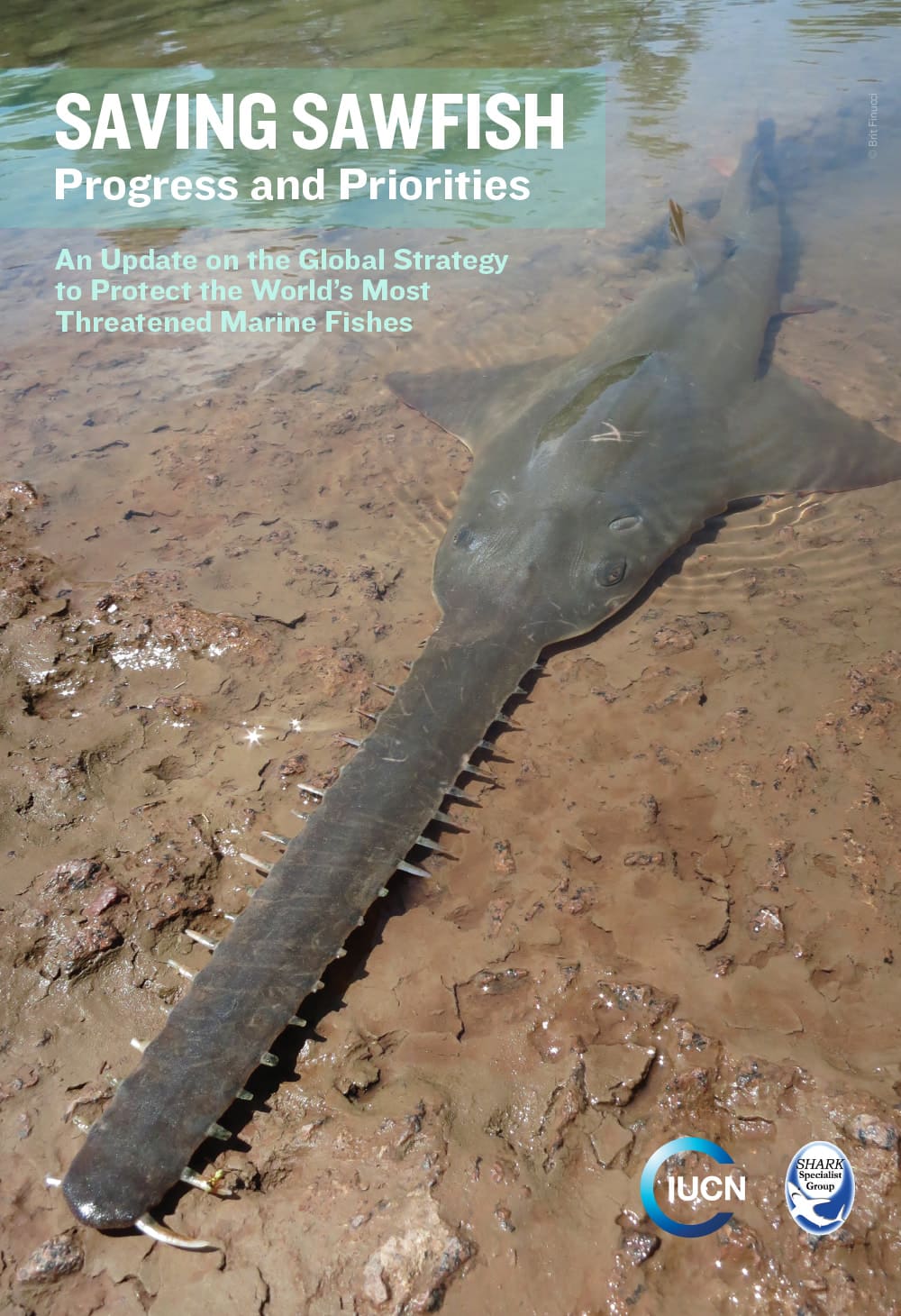
Saving Sawfish | Progress and Priorities
An Update on the Global Strategy to Protect the World’s Most Threatened Marine Fishes
Fordham SV, Jabado R, Kyne PM, Charvet P, Dulvy NK. 2018. Saving Sawfish: Progress and Priorities. IUCN Shark Specialist Group, Vancouver, Canada. 6 pp.