
January 21, 2014
A quarter of the world's sharks and rays are threatened with extinction, according to IUCN Red List™ criteria, with rays at greater risk than sharks
Gland, Switzerland | January 21, 2014
The findings, published today in the journal eLife, are part of a global assessment of 1,041 species conducted by the IUCN Shark Specialist Group. Ray and sharks are at substantially higher risk than most other groups of animals and have the lowest percentage of species considered safe. Overfishing is the main threat.
"Our analysis shows that sharks and their relatives are facing an alarmingly elevated risk of extinction," says Dr. Nick Dulvy, IUCN SSG Co-Chair and professor at Simon Fraser University. "In greatest peril are the largest species of rays and sharks, especially those living in shallow water that is accessible to fisheries."
Reported shark, ray, and chimaera catches peaked in 2003 and have been dominated by rays for 40 years. Unintentionally caught sharks and rays account for much of the catch, yet developing markets and depletion of targets have made this "bycatch" increasingly welcome.
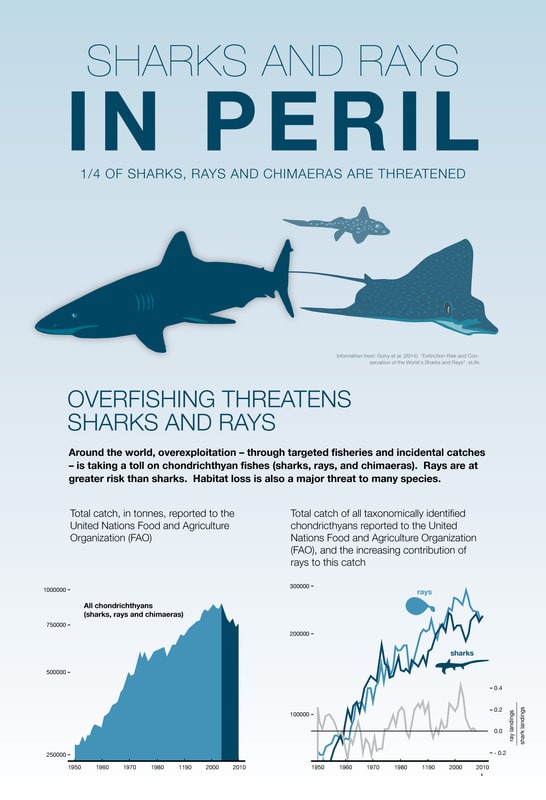 "We have found that the rays -- including sawfishes, guitarfishes, and stingrays -- are generally worse off than the sharks, with five out of the seven most threatened families made up of rays," says Dr. Colin Simpfendorfer, IUCN SSG Co-Chair and professor at James Cook University. "While attention to the plight of sharks is growing, the widespread depletion of rays is largely unnoticed. Conservation action for rays is lagging far behind, which only heightens our concern."
Demand for shark fin soup is a major factor in the depletion of sharks and some rays. Sharks, rays, and chimaeras are also sought for meat, and other products. Safeguards are generally lacking.
"Sharks, rays, and chimaeras tend to grow slowly and produce few young, leaving them particularly vulnerable to overfishing," says Sonja Fordham, IUCN SSG Deputy Chair and president of Shark Advocates International. "Significant policy strides have been made, but effective conservation requires a dramatic acceleration in pace as well as an expansion of scope to include all shapes and sizes of these exceptional species. The need for such action is urgent.
The rapid expansion of human activities threatens ocean-wide biodiversity. Numerous marine animal populations have declined, yet it remains unclear whether these trends are symptomatic of a chronic accumulation of global marine extinction risk. The first systematic analysis of threat for a globally distributed lineage of 1,041 chondrichthyan fishes (sharks, rays, and chimaeras) was published in the journal eLife in 2014.
This paper estimated that one-quarter are threatened according to IUCN Red List criteria due to overfishing (targeted and incidental). Large-bodied, shallow-water species are at greatest risk and five out of the seven most threatened families are rays. Overall, chondrichthyan extinction risk is substantially higher than for most other vertebrates, and only one-third of species are considered safe. Population depletion has occurred throughout the world’s ice-free waters, but is particularly prevalent in the Indo-Pacific Biodiversity Triangle and Mediterranean Sea. Improved management of fisheries and trade is urgently needed to avoid extinctions and promote population recovery.
Media Release
- IUCN Press Release: This eLife paper was released at the start of the year marking the 50th anniversary of The IUCN Red List. The findings are part of the first ever global analysis of these species carried out by the IUCN Shark Specialist Group (SSG).
- PRNewswire-USNewswire
- YouTube Video Summarizing Findings: SSG Co-Chairs and authors on the eLife paper, Nick Dulvy and Colin Simpfendorfer, summarize the findings of the eLife paper in this short video abstract.
- Infographic
- Fact Sheet, for an updated Fact Sheet Table click here
- Higher resolution images are available here.
- A summary of other media releases are available here
- The IUCN has developed "Amazing Species" profiles for the Giant Guitarfish (Rhynchobatus djiddensis), the Smooth Hammerhead Shark (Sphyrna zygaena), the Great Hammerhead Shark (S. mokarran), the Horn Shark (Heterodontus francisci), and the Dusky Smoothhound (Mustelus canis).